
The Zen of Motorcycle Maintenance: A Complete Guide

“Zen and the Art of Motorcycle Maintenance” explores quality through philosophy and mechanics. Pirsig’s 1974 book blends personal narrative with metaphysical discussions. It critiques modern education and technology. The book’s unique structure mirrors the author’s mental breakdown. It remains a cult classic.
The “Zen of motorcycle maintenance” refers to the philosophy of careful, mindful upkeep of a motorcycle as a way to achieve personal growth and technical mastery.
Think of it like tuning a musical instrument. Just as a guitarist adjusts the strings to perfect their sound, a motorcyclist maintains their bike to perfect their ride, and in doing so, finds a kind of moving meditation.
Key facts
- The “Zen of motorcycle maintenance” originates from Robert M. Pirsig’s 1974 book Understanding Zen and the Art of Motorcycle MaintenanceZen and the Art of Motorcycle Maintenance, which explores the intersection of motorcycle repair and philosophy.
- Pirsig’s philosophy distinguishes between “classical” and “romantic” values, arguing that motorcycle maintenance embodies both.
- The book’s narrator, Phaedrus, is a fictionalized version of Pirsig himself, who suffered a mental breakdown and underwent psycho surgery in the 1960s.
- The “Zen” in the title does not refer to Buddhist Zen but to a state of focused, mindful engagement with the task at hand.
01What is the “Zen of Motorcycle Maintenance”?
The “Zen of motorcycle maintenance” is not about Buddhism or even motorcycle mechanics. It’s about the mindset you bring to the work. Pirsig argues that maintaining a motorcycle requires both technical skill (“classical” values) and an appreciation for the process itself (“romantic” values). When you’re truly engaged in the work, you enter a state of focused awareness, much like the Zen Buddhist concept of “beginner’s mind”, a mindset of open, non-judgmental attention to the present moment.
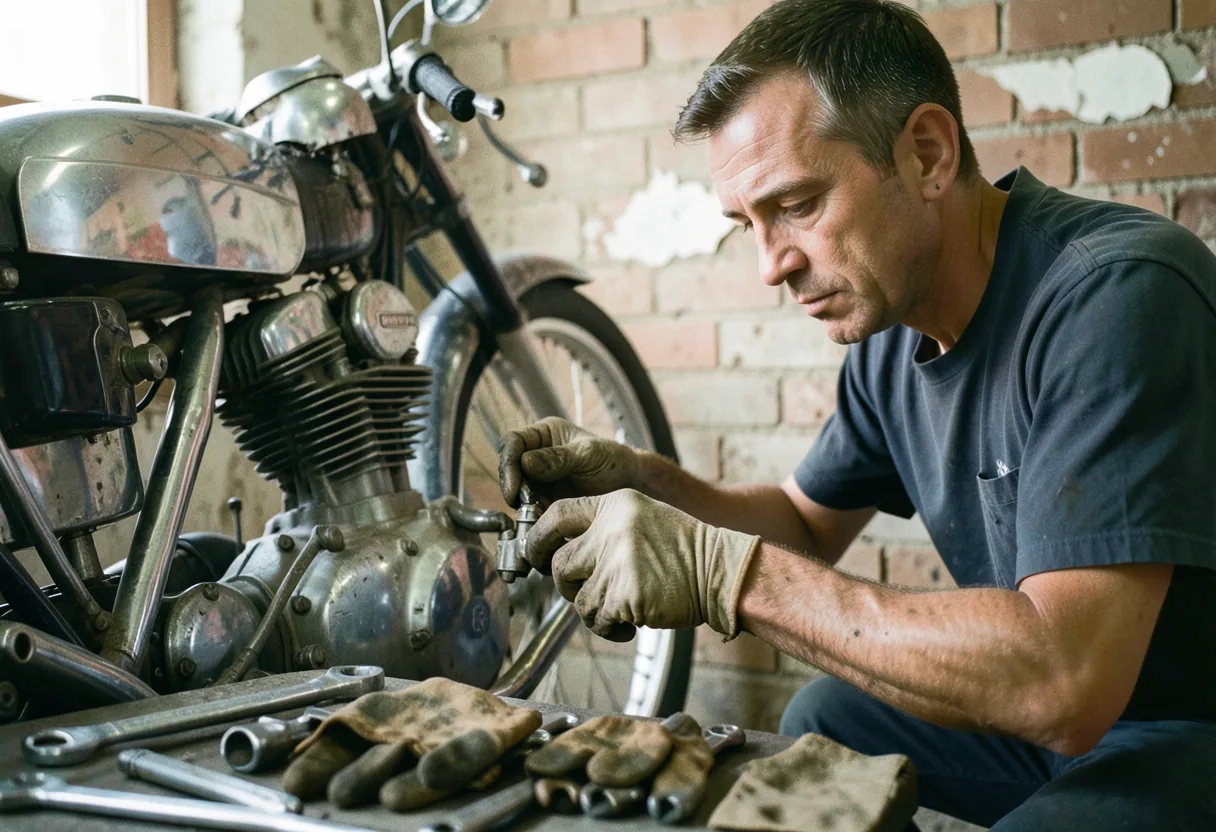
For example, when adjusting the valves on a vintage Harley-Davidson Sportster, you’re not just turning a screwdriver. You’re listening to the engine’s rhythm, feeling the resistance in the metal, and making microscopic adjustments until the machine purrs like a contented cat. This kind of engagement is what Pirsig calls “Quality,” the central concept of his philosophy. It’s the intangible, ineffable thing that makes something, whether a motorcycle, a poem, or a sunset, excellent.
02How does motorcycle maintenance relate to philosophy?
At its core, Understanding Zen and the Art of Motorcycle Maintenance argues that the act of motorcycle maintenance is a metaphor for living a good life. Pirsig uses the process of fixing and caring for a motorcycle to explore deep philosophical questions about the nature of reality, the meaning of life, and the relationship between the self and the world. He distinguishes between two ways of understanding the world: the “classical” mode, which values reason, logic, and objective truth, and the “romantic” mode, which values emotion, intuition, and subjective experience.
The first time I really looked at this idea, I was struck by how Pirsig describes the moment when a mechanic really “sees” the problem with a machine. It’s not just about diagnosing a faulty carburetor; it’s about perceiving the underlying patterns of cause and effect. This kind of insight, Pirsig argues, is not just technical knowledge, it’s a form of wisdom. And wisdom, he suggests, is what we’re all ultimately seeking, whether we’re turning a wrench or pondering the meaning of life.
03What are the practical steps to achieving the “Zen of motorcycle maintenance”?
Achieving the “Zen of motorcycle maintenance” is not about following a checklist, it’s about cultivating a mindset. However, there are practical steps you can take to get there. First, you need to develop your technical skills. This means learning the ins and outs of your motorcycle, from the basics of oil changes to more advanced tasks like valve adjustments or carburetor tuning. The Zen and the Art of Motorcycle Maintenance Summary offers a roadmap for this kind of hands-on learning.
Next, you need to approach the work with a sense of curiosity and openness. Pirsig emphasizes the importance of asking questions, about how things work, about why things are the way they are, and about what makes something good or bad. This kind of questioning is not just intellectual; it’s also emotional and intuitive. For example, when I’m working on my own bike, I often find myself pausing to appreciate the craftsmanship of the machine, how the metal has been shaped, how the parts fit together. This sense of wonder is a key part of the “Zen” mindset.
04How does the “Zen of motorcycle maintenance” apply to everyday life?
The “Zen of motorcycle maintenance” is not just about fixing bikes, it’s about approaching life with the same sense of engagement and curiosity. Pirsig argues that when we’re truly present in the moment, whether we’re changing a spark plug or having a conversation with a friend, we’re experiencing “Quality.” This concept is central to his philosophy and is explored in depth in the Plot Breakdown of Zen and the Art of Motorcycle Maintenance.
For example, think about the last time you were deeply engaged in a task, maybe cooking a meal, gardening, or even playing a video game. Chances are, you were so focused on what you were doing that you lost track of time. This is the kind of engagement Pirsig is talking about. It’s not about the end result; it’s about the process itself. And when we cultivate this kind of engagement in our daily lives, we’re not just being more productive, we’re also being more alive.
05The philosophy of Phaedrus and its impact
Phaedrus, the narrator of Understanding Zen and the Art of Motorcycle Maintenance, is a deeply flawed but profoundly insightful character. His philosophy is shaped by his experiences with mental illness, his love for teaching, and his passion for motorcycle maintenance. Pirsig uses Phaedrus to explore the idea that true understanding comes not from abstract theory but from direct, hands-on experience. This idea is revolutionary in a culture that often values abstract knowledge over practical skill.
The philosophy of Phaedrus has had a lasting impact on both the motorcycle community and the world of philosophy. It has inspired countless readers to pick up a wrench and start tinkering with their own bikes, and it has also sparked debates about the nature of reality, the meaning of life, and the relationship between the self and the world. For a deeper dive into Phaedrus’ philosophy, check out the Phaedrus and the Philosophy in Zen and the Art of Motorcycle Maintenance.
06How to start practicing the “Zen of motorcycle maintenance”
If you’re new to motorcycle maintenance, the best place to start is with the basics. Learn how to change the oil, check the tire pressure, and adjust the chain. These tasks might seem mundane, but they’re the foundation of all motorcycle maintenance. As you become more comfortable with these basics, you can start tackling more advanced tasks, like valve adjustments or carburetor tuning.
But remember, the “Zen of motorcycle maintenance” is not just about the mechanics, it’s about the mindset. As you work on your bike, try to cultivate a sense of curiosity and openness. Ask questions, experiment, and don’t be afraid to make mistakes. And above all, try to be present in the moment, fully engaged in the task at hand. This is the heart of the “Zen” mindset, and it’s what makes motorcycle maintenance so much more than just a chore.
07Books and resources for learning the “Zen of motorcycle maintenance”
If you’re interested in learning more about the “Zen of motorcycle maintenance,” there are plenty of resources available. The obvious starting point is Understanding Zen and the Art of Motorcycle Maintenance itself, which is a profound and thought-provoking exploration of the philosophy behind motorcycle maintenance. For a summary of the book’s key ideas, check out the Zen and the Art of Motorcycle Maintenance Summary.
In addition to Pirsig’s book, there are many other resources available for learning about motorcycle maintenance. Online forums, YouTube channels, and motorcycle clubs can all be great sources of information and support. And if you’re looking for a more structured learning experience, consider enrolling in a motorcycle maintenance course. The Zen and the Art of Motorcycle Maintenance Review offers a great overview of some of the best courses available.
08The “Zen of motorcycle maintenance” and the art of living
The “Zen of motorcycle maintenance” is ultimately about more than just fixing bikes, it’s about living a good life. Pirsig argues that when we approach our work with a sense of curiosity and engagement, we’re not just being more productive, we’re also being more alive. This idea is explored in depth in the Best Quotes from Zen and the Art of Motorcycle Maintenance, which offers a collection of Pirsig’s most insightful and thought-provoking quotes.
So whether you’re a seasoned mechanic or a complete novice, there’s something to be learned from the “Zen of motorcycle maintenance.” It’s a philosophy that can enrich your life, deepen your understanding of the world, and help you find a sense of meaning and purpose in even the most mundane tasks. And isn’t that what we’re all ultimately seeking?
Start small. Pick up a wrench, ask a question, and see where the journey takes you.
09Frequently asked questions
What’s the core philosophy behind ‘The Zen of Motorcycle Maintenance’?
The book argues that quality is found in the process, not just the product. Author Robert M. Pirsig contrasts ‘classic’ values, like deep understanding and craftsmanship, with ‘romantic’ values that prioritize emotional experience over technical mastery. He uses motorcycle repair to illustrate this, emphasizing that true quality emerges from thoughtful, deliberate work.
How does Pirsig link motorcycle maintenance to Zen Buddhism?
Pirsig equates motorcycle maintenance with Zen practice, where focus on the present moment and meticulous attention to detail lead to a state of flow. He writes, ‘The real motorcycle trip will not be the one you made last summer, but the trip you will make next summer.’ The act of fixing a bike becomes a meditation on quality and mindfulness.
What’s the significance of the character John Sutherland?
John Sutherland is Pirsig’s former student and later antagonist, representing the romantic approach that rejects technical rigor. Their debates drive the book’s central conflict. Sutherland’s insistence on feeling over thinking mirrors Pirsig’s critique of modern education’s neglect of practical, hands-on skills.
Why did the book face publication challenges?
Published in 1974 after years of rejection, the book blends memoir, philosophy, and technical writing, a hybrid form that baffled publishers. Pirsig’s exploration of quality as a metaphysical concept also defied genre expectations. It became a cult classic, selling over 5 million copies, proving its lasting appeal.