
Plot Breakdown of Zen and the Art of Motorcycle Maintenance
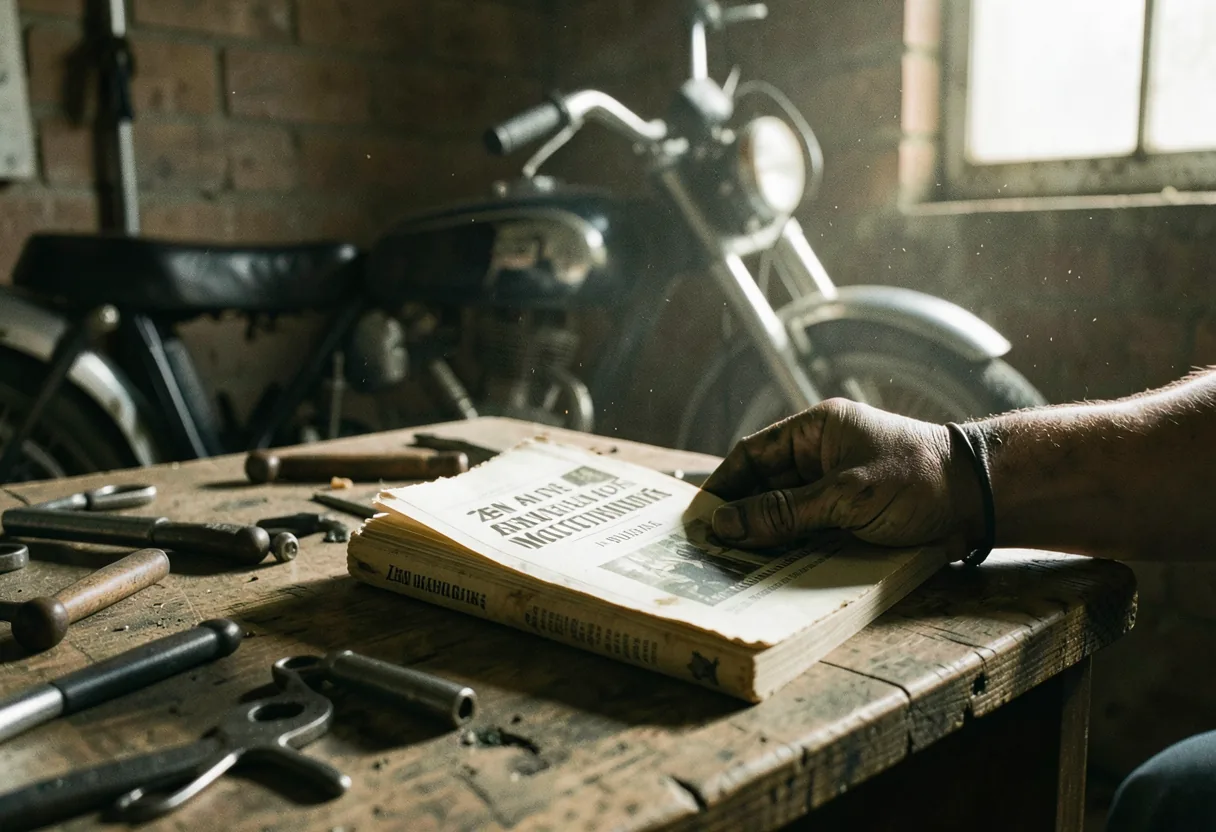
Zen and the Art of Motorcycle Maintenance follows a father, Pirsig, and his son, Chris, on a cross-country motorcycle trip with friends John and Sylvia. The novel explores Pirsig’s mental breakdown and his quest to reconcile Eastern philosophy with Western technology, blending personal memoir with philosophical inquiry.
Zen and the Art of Motorcycle Maintenance is a narrative framework that explores the philosophy of quality through the lens of motorcycle maintenance, weaving together a cross-country road trip with deep philosophical inquiry.
Imagine disassembling a motorcycle engine piece by piece, then reassembling it, this process mirrors the book’s approach to understanding life, breaking down complex ideas into manageable parts to reveal their underlying quality.
Key facts
- The book was published in 1974 and became a bestseller, blending personal narrative with philosophical exploration.
- It follows a father, Phaedrus, and his son Chris on a motorcycle trip from Minnesota to California.
- The narrative alternates between the journey, philosophical discussions, and the story of Phaedrus’ mental breakdown and reinvention.
- The book critiques both Romantic and Classical philosophies, advocating for a balanced approach to life and work.
01What is the central plot of Zen and the Art of Motorcycle Maintenance?
The central plot revolves around a father and son’s motorcycle trip, which serves as a backdrop for exploring the philosophy of quality. The narrative alternates between vivid descriptions of the journey, philosophical musings, and the backstory of Phaedrus, a former university professor who underwent a mental breakdown and reinvented himself as a motorcycle mechanic. The trip becomes a metaphor for the pursuit of quality in all aspects of life, blending practical skills with abstract thought.
Phaedrus’ character is central to the plot, representing the search for meaning and the struggle to reconcile the technical (Classical) and emotional (Romantic) aspects of existence. His past as a professor and subsequent transformation into a mechanic symbolize the book’s core theme: the integration of reason and emotion to achieve true quality.

02How does motorcycle maintenance illustrate the book’s philosophical themes?
Motorcycle maintenance in the book is more than a practical skill; it’s a metaphor for the pursuit of excellence and the understanding of quality. The process of fixing and tuning a motorcycle requires both technical knowledge and an intuitive sense of what works best, mirroring the book’s philosophical inquiry. By breaking down the complex task of maintenance into manageable steps, the narrator illustrates how one can approach life’s challenges with the same methodical and thoughtful approach.
The book contrasts the Romantic view, which values emotion and intuition, with the Classical view, which emphasizes reason and technical skill. Motorcycle maintenance embodies the Classical approach, but the narrator argues that true quality comes from balancing both perspectives. For example, fixing a motorcycle isn’t just about following a manual (Classical); it also involves an intuitive understanding of the machine’s needs (Romantic).
03What is the significance of Phaedrus’ backstory in the plot?
Phaedrus’ backstory is crucial to the plot as it embodies the book’s central themes of mental health, reinvention, and the search for quality. Before the trip, Phaedrus was a university professor who suffered a mental breakdown due to his obsession with understanding quality. His breakdown led him to reject his academic life and become a motorcycle mechanic, adopting the name Phaedrus after a historical philosopher. This transformation represents the book’s critique of modern education and society, which often separate technical and emotional aspects of life.
The backstory also highlights the personal struggle behind the philosophical inquiries. Phaedrus’ mental health issues and his subsequent reinvention serve as a reminder that the pursuit of quality is deeply personal and often involves overcoming significant challenges. His journey from academia to mechanic underscores the book’s message that true understanding comes from integrating different aspects of one’s life and experiences.
Comparison of Philosophical Approaches
04How does the road trip structure the narrative and philosophical exploration?
The road trip serves as the narrative framework, providing a sense of movement and progression that mirrors the philosophical journey. Each leg of the trip introduces new challenges and insights, from mechanical issues to philosophical discussions with fellow travelers. The physical journey, spanning diverse landscapes from Minnesota to California, symbolizes the broader journey of self-discovery and the pursuit of quality. For instance, the narrator’s detailed descriptions of the countryside and small towns along the way highlight the beauty and complexity of everyday experiences, reinforcing the book’s theme that quality can be found in all aspects of life.
The trip also allows for the introduction of various characters and situations that illustrate different philosophical viewpoints. Conversations with fellow travelers, encounters with locals, and even mechanical breakdowns become opportunities to explore the book’s themes. For example, a breakdown in the middle of nowhere forces the narrator and his son to rely on their technical skills and resourcefulness, demonstrating the practical application of the Classical approach. At the same time, their shared experience of overcoming the challenge strengthens their emotional bond, illustrating the Romantic perspective.
Key Themes and Their Representation in the Plot
05How does the book critique modern education and society?
The book critiques modern education and society by highlighting the separation of technical and emotional aspects of life. Phaedrus’ backstory illustrates how the academic system often values abstract knowledge over practical skills, leading to a disconnect between theory and real-world application. The book argues that this separation undermines the pursuit of quality, as true understanding requires both technical expertise and emotional engagement. For example, Phaedrus’ mental breakdown is partly attributed to his frustration with the academic system’s inability to address the practical aspects of quality.
The book also critiques society’s tendency to compartmentalize different aspects of life, such as work and leisure, reason and emotion. The narrator argues that this compartmentalization leads to a shallow understanding of the world and a lack of fulfillment. By contrast, the motorcycle trip serves as a microcosm of life, where the narrator and his son must integrate different skills and perspectives to overcome challenges and appreciate the journey. This holistic approach to life is presented as a more fulfilling and meaningful alternative to the fragmented existence criticized in the book.
06What are the key takeaways from the plot of Zen and the Art of Motorcycle Maintenance?
- Quality is a holistic concept that integrates both technical and emotional aspects of life.
- The pursuit of quality requires a balanced approach, combining reason and intuition.
- Personal experiences and challenges, such as Phaedrus’ mental breakdown, are integral to understanding and achieving quality.
- The road trip serves as a metaphor for the journey of self-discovery and the continuous pursuit of quality.
- Modern education and society often separate technical and emotional aspects of life, undermining the pursuit of quality.
07How does the plot of Zen and the Art of Motorcycle Maintenance relate to real-life motorcycle maintenance?
The plot of Zen and the Art of Motorcycle Maintenance offers valuable insights into real-life motorcycle maintenance by emphasizing the importance of understanding the underlying principles of the craft. The book’s detailed descriptions of motorcycle repair and maintenance highlight the technical skills required, but it also stresses the need for an intuitive understanding of the machine. For example, the narrator’s discussion of the importance of proper lubrication and the role of different engine parts in performance can be directly applied to real-life maintenance tasks. The book’s emphasis on quality over mere functionality encourages motorcycle owners to take a more thoughtful and engaged approach to maintaining their machines.
The book also underscores the value of hands-on experience and learning from mistakes. The narrator’s descriptions of troubleshooting mechanical issues and the trial-and-error process of repair reflect the real-life challenges of motorcycle maintenance. By emphasizing the importance of patience, attention to detail, and a willingness to learn, the book provides a practical guide for anyone looking to improve their motorcycle maintenance skills. The integration of philosophical inquiry with practical advice makes the book a unique and valuable resource for both novice and experienced mechanics.
The first time I really looked at a motorcycle engine, I saw a complex array of parts and wires that seemed overwhelming. But after reading Zen and the Art of Motorcycle Maintenance, I began to appreciate the engine as a system of interconnected components, each with its own purpose and role. This shift in perspective transformed my approach to maintenance, making it a more rewarding and meaningful experience. The book’s emphasis on understanding the underlying principles of motorcycle maintenance has made me a more confident and capable mechanic, and it has deepened my appreciation for the craft.
Understanding the plot of Zen and the Art of Motorcycle Maintenance is just the beginning. The book’s profound insights into quality, philosophy, and personal growth can be applied to all aspects of life, making it a timeless and valuable read.
08Frequently asked questions
Who is the narrator in Zen and the Art of Motorcycle Maintenance?
The narrator is Pirsig himself, though he remains unnamed. He recounts a 17-day motorcycle trip from Minnesota to Northern California with his son Chris, friends John and Sylvia, and John's son Mark. The narrative blends personal experience with philosophical musings.
What is the significance of the motorcycle in the book?
The motorcycle serves as a metaphor for understanding technology and life. Pirsig's meticulous maintenance of the motorcycle parallels his exploration of "Quality," a concept he argues is central to both art and technology. The book's famous 1968 motorcycle trip is a case study in this philosophy.
What is the relationship between Pirsig and his son Chris?
Pirsig's relationship with his son Chris is strained and complex. Chris, who suffers from a learning disability, often struggles with the trip's demands. Pirsig's reflections on their interactions reveal his personal struggles with fatherhood and mental health, including his past electroconvulsive therapy.
What is the "Greek" perspective on technology in the book?
The "Greek" perspective, represented by Pirsig's former colleague, views technology as a rational, analytical pursuit. It prioritizes efficiency and utility, often at the expense of emotional or artistic value. Pirsig contrasts this with the "Romantic" perspective, which values intuition and emotion.